
One of the most interesting musical features about Krust’s productions are his unique time signatures which can extended up to twelve minutes in length and his long intro’s which on average would last two to three minutes. Krust was determined to create music that would challenge the senses and perceptions of the listeners with off beat bass-lines and unpredictable surprises. His desire was to create unsettling tension followed by rejoicing release slowly building up with patience. They were unlike anything else around the time and have aged incredibly well.Krust’s 1997 classic hit ” Warhead” was no exception notably the infamous bass-line ( Jenkins 2018).
Lets start with the drums the main pattern which consists of layerd breaks is a classic two step pattern which is commonly associated with early drum and bass especially tracks released within this era. Kick would be usually placed on the first beat and between the third and the fourth beat which is referred to as the off beat a technique that is affiliated with hip hop production. The snare will placed on the second and the fourth beat. With the hi hat placed on every eight note helping to create a bit of swing to the groove. What is noticeable Krust appears to using a ghost snare for first intro pattern which is interesting because most drum and bass producers use this method to utilize more syncopation within the pattern but not Krust. The idea is to place another slightly quieter or short snare often pitched down on the sixteenth note which with second hi hat often placed on the same notes creates a nice shuffle pattern.
Instead Krust has chosen to layer the main snare pattern from another break which has much slower attack with a little more delay to help create a longer tail end. Which was properly filtered with a pitch envelope he may even had tried to modulate a noise wave to create that synthetic sound using oscillator modulation. This would make sense as there are some not so subtle variations throughout the songs arrangement. Krust also uses drum fills or rolls to help create the extra energy before the drops which is a technique commonly used to build momentum on the dance floor. Some are more subtle than others with the velocity being a key focal part which makes perfect sense because those are the parts of the song which need more of an energetic boost. Something else that is quite clear is that Krust decided to build the momentum of the song by slowly introducing each pattern every eleven seconds as he started to layer the breaks.
Honestly this is not usually herd of within this genre and not commonly associated with drum and bass intros but Krust appears to pride himself on being different as an artist,which seems apperent if you have ever had the pleasure of listen to his interviews. He also uses subtle variation with the drum loops throughout the track strategically changing rhythmic patterns by breaking them up with the use of changing the directions very slightly so for a blink second it almost sounds a little offbeat which compliments the not so subtle hi hat pattern which is quite intense at points with the velocity I would presume to keep that energy.The final analysis to mention about this rhythmic section is the introduction of the main percussion part which is also quite bright a shaker. At first sounds like an egg shaker but after listening to it again the sound is more likely to be maracas using an eight note rhythm also known technically as staccato sound or a snapping sound. Although my analysis could easily be wrong I am quietly confident that the two fore-mentioned instruments are the likely possibilities.
Krust experimented with Musique Concrete when making the bass-lines for “Warhead” which ironically would clear dancefloors for the first eleven months of circulation. Krust actually touched one of wire he was pluging in then recorded the humming feedback which he then sampled into his Roland 760 sampler.

http://synpro.heimat.eu/roland_s760.htm
Now I can not be sure fot certain but there seems to me to be some modulating of the cutoff frequency of the low pass filter using low frequency oscillators. This would obviously create that distinctive opening and closing effect which gives the bass a little wobble. Listening to the song there are handful of variations of basslines including the opening subbass which is the distinctive sound of the sampled hum. This would also make perfect sense with the reasoning behind pitching the sounds up and down octaves which was previousily mentioned. After all it helps to create rythmic movement within the bass having low tones and high tones variations. Once again this is often not overly subtle in its execution or even sharp and clear cut. Personally I feel that DIY approach adds grit and character sometimes its better to not have such clean sounding productions especially within this genre.
There also appears to be some slight distoration on some of the bass-lines and if I had to guess a foghorn effect going on which is classic to drum and bass. This also seemed to have some pitch modualations helping it to rise to an ear piercing level at points I guess he was trying to tantalize the clubbers senses. Which leads me up to the remaining sounds and samples these consisted from chopped samples for sweeps some sharp others with a little delay with pitch variations and what I think is ring modulation being used to create the phase effects. These sounds seem to fit Krust personality he is a self confessed movie fan and has even quoted in interviews that he likes to incorporate film music within his productions in fact the Film ‘Bladerunner’ and Starwars were the influence behind ‘Warhead’.
Which makes sense with all the phaze and high pitched risers cutting through the mix. Another sound that really caught my attention was the metallic component which seem to follow either a sweep or the drum fills this really interested me because of its add texture. If I had to make a guess then this was definitely some smart sampling once again using Musique Concrete which he recorded either himself or someone else hitting a piece of sheet metal with a blunt object. Finally but not least there is an woodblock allthough you really have to hone your ears on it in order to hear it because it is so gentle.
Finally the equipment well I mentioned earlier about the Roland 760 sampler which he used with a turntable a microphone and I guess a collection of records to achieve the sounds. This was being run through an old busted up twelve channel mixer into an Atari ST computer running Atari’s very own sequencing software C-Lab creator Notator which comparison with todays market is archaic.
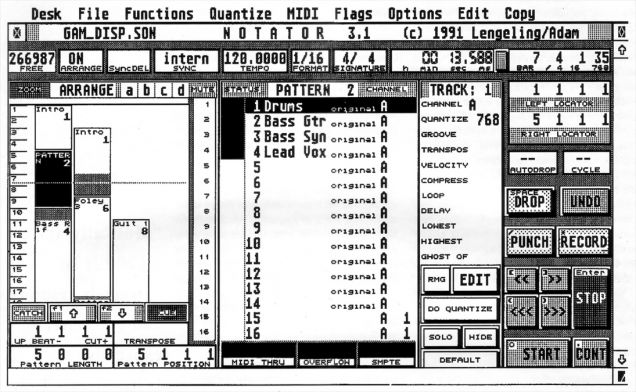
http://www.muzines.co.uk/articles/c-lab-creator-notator-3-1/928
That is pretty much it in terms of equipment but they do say the less you have with limitations the more creative you become.
Krust admits the track was made within direct competition with Roni Size and DJ Die ” Mad Professor” released around the same time they would often all compete against each other. They have all admitted overtime that healthy competition helped the group Reprazent and as indivduals develop in their producing.After listening to Roni and DJ Die ” Mad Professor” Krust described going home and making the track because it was a heavy tune with vibes and he wanted to recreate something with the same energy ( Red-bull music academy 2019).
He recalls handing the track over to Bryan [Gee] he like so many at the beginning could not understand it. After a year though the track became very popular on the dance floor and was a hit. In fact this timescale has become a blue print for all Krust’s releases ever since and he often explains that in his tutorial speeches at seminars ( Red-bull music academy 2019).
Krust looks at sounds as if they’re colours, vibrations that fit together in a very specific way – or not. Sometimes it’s good if they don’t fit and they don’t want to work together, then that’s an opening for something new to occur. Like so many musicians he is trying to feel new emotions. Krust likes to work against the norm so when he gets something that’s not supposed to work he knows he is heading in the right direction. This can take anywhere between a week to a month. What he likes about the digital domain is you don’t have to finish anything right away. This is both good and bad…(Fact 2014).
” Warhead” like all of his compositions really depicts that formula from the rich textured sounds a made up from samples and synthesis combined together with well crafted re-sequenced breakbeats and off- beat bass-lines. A lengthy time signature in just over eight minutes with a added intro and allthough often quite heavy tracks like this show the true indication of Krust sonic sound. If I had to pick one specific one particular element to describe Krust sonic signature it would be his break layering drum patterns ,it’s clear to me and should be to others that there is huge hip hop influence within his productions and music.
Bibliography and Discography
[Online] Available at: [https://www.factmag.com/2014/06/01/krust-breaks-down-his-three-vital-studio-tools/] [Accessed 15th October 2019]
[Online] Available at: [https://ukf.com/words/nobody-db-like-krust/21213 [Accessed 15th October 2019]
[Online] Available at: [https://www.redbullmusicacademy.com/lectures/krust-planets-rock] [Accessed 15th October 2019] Image [Online] Available at:[http://www.muzines.co.uk/articles/c-lab-creator-notator-3-1/928]Accessed 15th October 2019]
[Online] Available at: [https://www.youtube.com/watch?v=9hJ4OROIvxY ] [Accessed 15th October 2019]
Image [Online] Available at:[https://www.facebook.com/Dj.Krust/] [Accessed 15th October 2019]
Image [Online] Available at:[http://synpro.heimat.eu/roland_s760.htm][Accessed 15th October 2019]
 MUSIC BLOG